The 7 day return rule
MetricsExactly what counts as a returning player, why the rule changes on a network that runs a login plugin, and how Day 1, Day 7, and Day 30 differ.
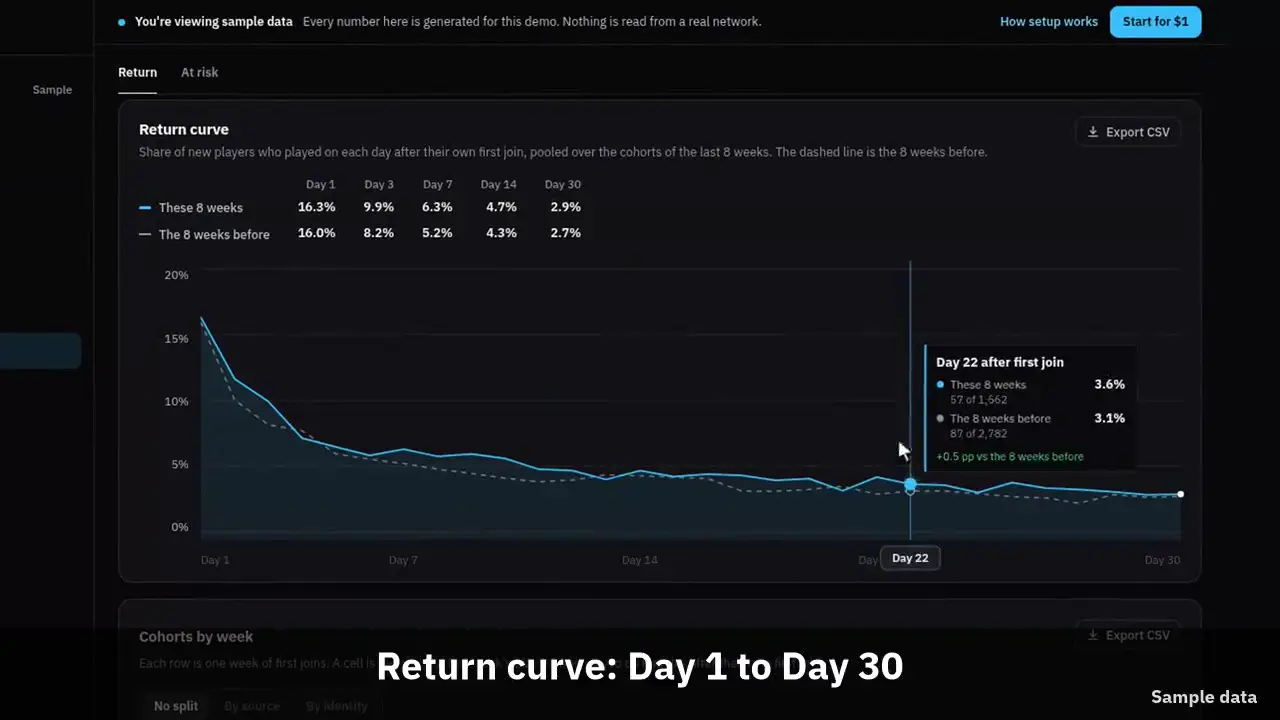
The clip shows, in order:
- Return curve: Day 1 to Day 30.
- Weekly cohorts, one row per week of first joins.
- Players at risk: regulars who went quiet.
#The rule
A player counts as returned when they start another session after their first one, inside seven days of that first join, and that session qualifies.
A session qualifies when a login was confirmed, or, on a network with no login system, when it lasted at least 180 seconds. That fallback is what stops a reconnect loop or a port scan from reading as retention.
| Setting | Value |
|---|---|
| Return window | 7 days from the first join |
| Minimum session without a login system | 180 seconds |
| Sessions counted | Any session after the first one |
#Networks with a login plugin
On a network that runs a login system for cracked players, only a confirmed login qualifies. The 180 second fallback is withdrawn, because on such a network a long session with no login is a failed login, and a failed login is not a return.
We decide this from confirmed logins by cracked players only. A premium or Bedrock player is authenticated by the platform at join, so counting those would flip every network into login mode and silently break the number for its cracked players.
#Pending players
A player whose seven days are not up yet is shown as pending, not as a failure. Return rate is measured against the cohort whose window has closed, so today's joins do not drag yesterday's number down.
On a young network no window has closed yet, so there is nothing to divide. The dashboard then shows what it already knows, marked so far: how many of the open windows have seen the player come back. The tile names the day the first windows close, and from that day the matured rate takes over as the official number. Once some windows have closed, the matured rate is the headline again and a muted line counts the returns still sitting in open windows, so a known return is never hidden.
#Day 1, Day 7, and Day 30
The 7-day return rate on Overview, Growth, and Players asks whether a player came back at any time in their first seven days. The Retention page asks a narrower question: did they play on one given day after their first join.
A numbered day is the 24 hours that begin that many days after the player's own first join, so Day 7 is the seventh day only. A session counts on the same terms as above, and a player whose day has not ended yet is pending and left out, so a card reads Pending instead of 0% until the first day closes.
The page also has a return curve for every day from Day 1 to Day 30, a grid of weekly cohorts that splits by join address or identity type, and a list of players at risk: regulars who played on at least 3 different days in the last 30 and have not been seen for 7 days or more.
On the Network plan and up, the page adds a cohort table you can group by day, week or month and filter by source, server, identity and country, and a score that ranks players at risk and says why. That part has its own page, Churn risk.
| Number | Where | Counts a return |
|---|---|---|
| 7-day return rate | Overview, Growth, Players | At any time in the first 7 days |
| Day 1 return | Retention | On the first day after the first join |
| Day 7 return | Retention | On the seventh day only |
| Day 30 return | Retention | On the thirtieth day only |